

Leaving money in a bank account can feel like the obvious choice. It is easy to understand, easy to access, and the amount in the account does not usually jump around from one day to the next.
Investing is different.
When you invest, you put money into something that may become more valuable or produce income in the future. That could mean buying shares in a company, holding bonds, investing through a fund, or owning other assets. The value of those investments can move in either direction, which is one of the main differences between investing and simply keeping money in cash.
So why do people take that risk?
How Can Investing Help Build Wealth?
The most obvious reason is growth.
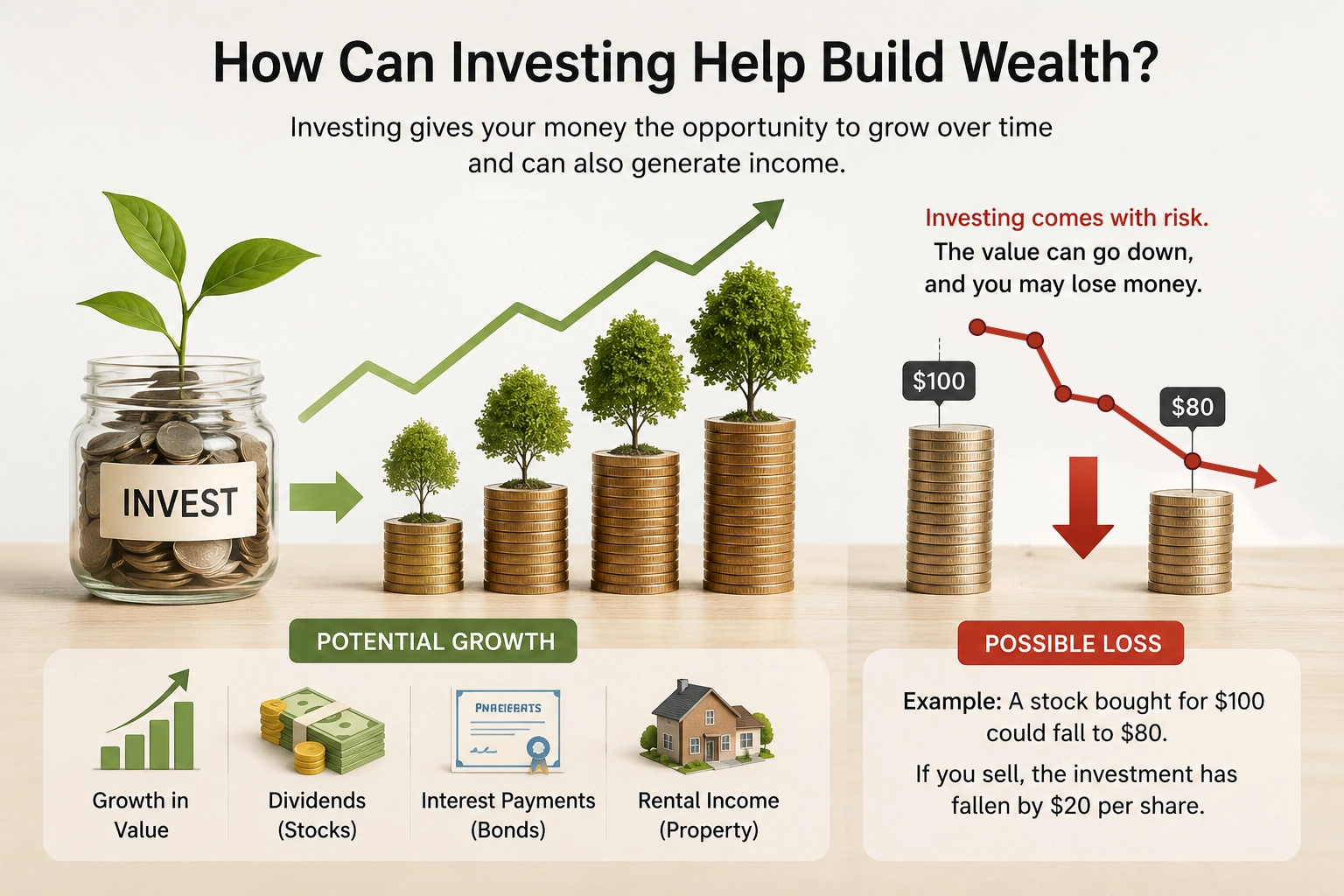
Imagine putting money into an investment and leaving it there for several years. If the asset increases in value, your original money becomes worth more. Some investments can also pay income along the way.
A company, for example, may distribute part of its profits to shareholders through dividends. A bond may pay interest to the investor. Property can produce rental income. The way money is earned varies from one investment to another.
There is also the possibility of losing money. A stock bought for $100 could later be worth $80. If you sell at that price, the investment has fallen by $20 per share.
That uncertainty is part of investing.
Can Investing Help Protect Against Inflation?
There is something else worth considering when deciding what to do with your money: purchasing power.
Prices tend to change over time. A basket of groceries, a car, rent, or a university education may cost considerably more in the future than it does today.
Suppose you keep $10,000 in cash for many years. You would still have $10,000 in nominal terms, but that money may buy less than it does today if prices have risen during that period.
This is where investing enters the conversation. People may invest because they want their money to have an opportunity to grow over the long term rather than allowing inflation to gradually reduce what that money can buy.
It is worth keeping the other side in mind, though. An investment does not automatically beat inflation. Some investments lose value, sometimes for extended periods.
Why Is Time Important When Investing?
Investing tends to make more sense when you have time on your side.
Markets rarely move in a straight line. A company can have a disappointing year. Interest rates can change. An economic slowdown can push several asset prices lower at the same time.
Over a short period, these movements can make a large difference to the value of a portfolio.
Someone investing for a goal several decades away has a different situation from someone who expects to need the money next year. The longer time horizon provides more opportunity to experience different market conditions, although it does not guarantee a positive return.
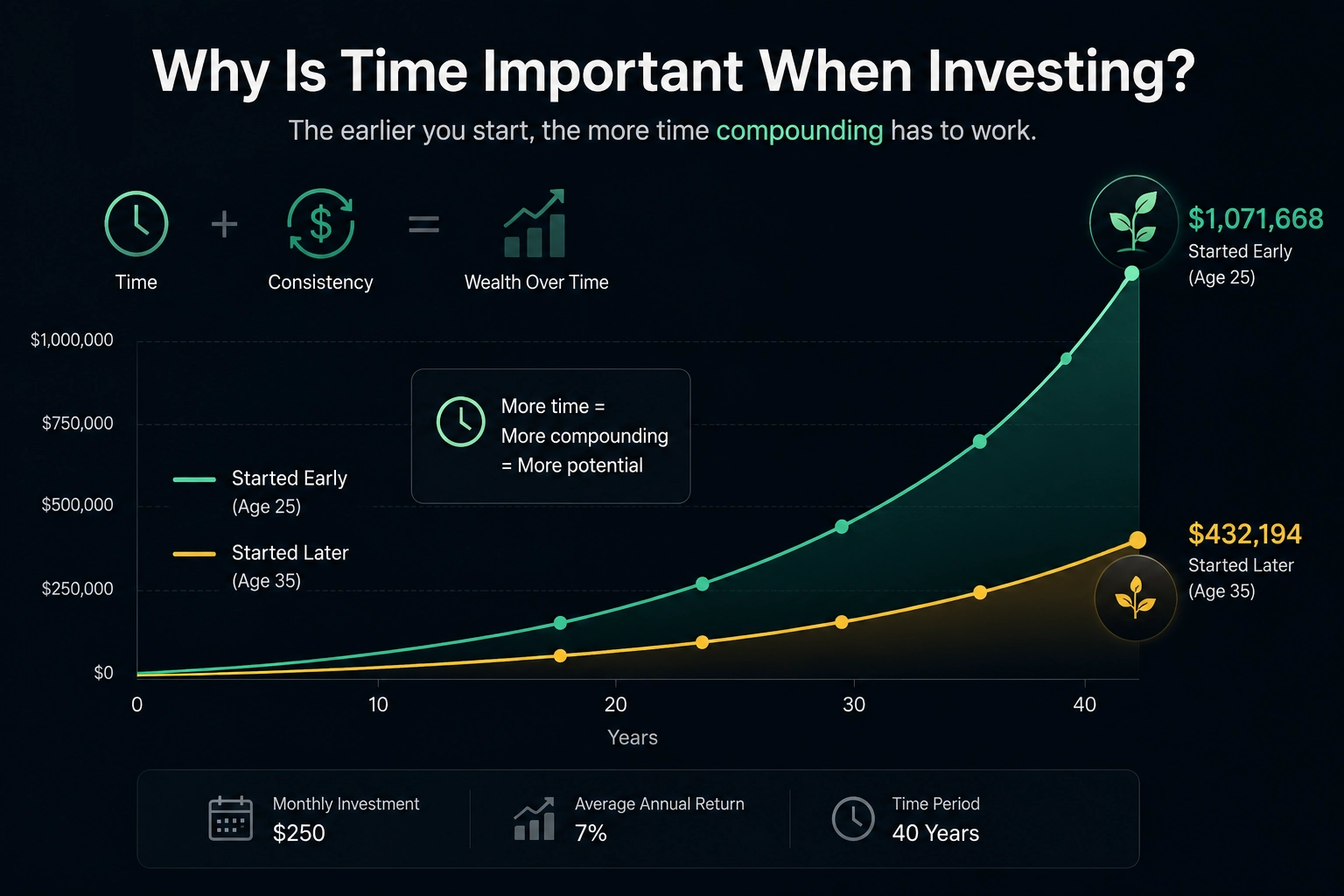
This is also one reason starting early can matter.
You do not necessarily need a large amount of money on day one. Regular contributions made over many years can gradually build the amount invested.
How Does Compound Growth Work?
The idea is fairly simple. Investment earnings remain invested, and those earnings can generate further earnings.
Say you invest $5,000 and it grows to $5,500. If that additional $500 stays invested, future growth applies to the larger balance rather than just the original $5,000.
Repeat that process over many years and the difference can become substantial.
The same principle applies when you continue adding money. New contributions increase the amount working in the market, while reinvested earnings can add another source of growth.
Actual investment returns, of course, do not arrive at a steady rate every year. A portfolio might gain one year and lose value the next. Compounding is most useful as a long-term concept, rather than a promise of a particular outcome.
How Does Diversification Help Manage Investment Risk?
Putting all your money into one investment creates a fairly simple problem: there is nowhere else for your money to go if that investment performs badly.
Suppose an investor owns shares in only one company. A major change in that company’s business could have a direct effect on the entire portfolio.
Holding several investments changes the exposure.
An investor might own shares in different industries, along with bonds or funds containing many securities. This is known as diversification. The idea is straightforward: one disappointing investment has less influence when it represents only part of the overall portfolio.
Diversification has limits. If markets fall broadly, different investments can decline together. It reduces concentration, rather than removing investment risk altogether.
What Is the Difference Between Saving and Investing?
That does not make saving unnecessary.
Money set aside for an emergency usually needs to be available when you need it. A savings account can make more sense for that purpose because the value does not normally fluctuate with the stock market.
Investments are better suited to money that can remain invested for a longer period.
Think about the difference between needing $5,000 in three months and saving for retirement several decades from now. The first situation leaves little room to wait through a market decline. The second gives an investor much more time to deal with temporary changes in value.
The purpose of the money matters.
What Should You Consider Before Investing?
Before putting money into an investment, it helps to know why you are investing in the first place.
Is the money intended for retirement? A future home? Education? Or simply long-term wealth building?
The answer can affect how long you expect to stay invested and how much volatility you may be willing to accept.
It is also worth looking at the investment itself. How does it generate a return? What could cause its price to fall? Are there fees involved? How easily can you sell it if you need the money?
These questions do not predict what an investment will do. They give you a clearer idea of what you are actually buying.
The Bottom Line
People invest because they want their money to have an opportunity to do more over time.
Growth, investment income, compounding, and the possibility of keeping pace with inflation are among the reasons investing can be useful for long-term financial goals. At the same time, prices can fall and losses are always possible.
Starting early gives compounding more time to work, while diversification can reduce dependence on any single investment. The amount of risk that makes sense depends on the person, the investment, and when the money will be needed.
For anyone thinking about investing, a reasonable place to begin is with those three questions: What is the money for? How long can it stay invested? And what happens if its value falls?




Leave a Reply