If your trading strategy relies on monitoring shifts in market momentum, you probably pay close attention to an asset’s order book. There, you see bids and offers as buyers and sellers compete to dominate the market.
But do you know that millions of shares change hands without appearing on a stock exchange’s order book?
Welcome to the world of dark pools.
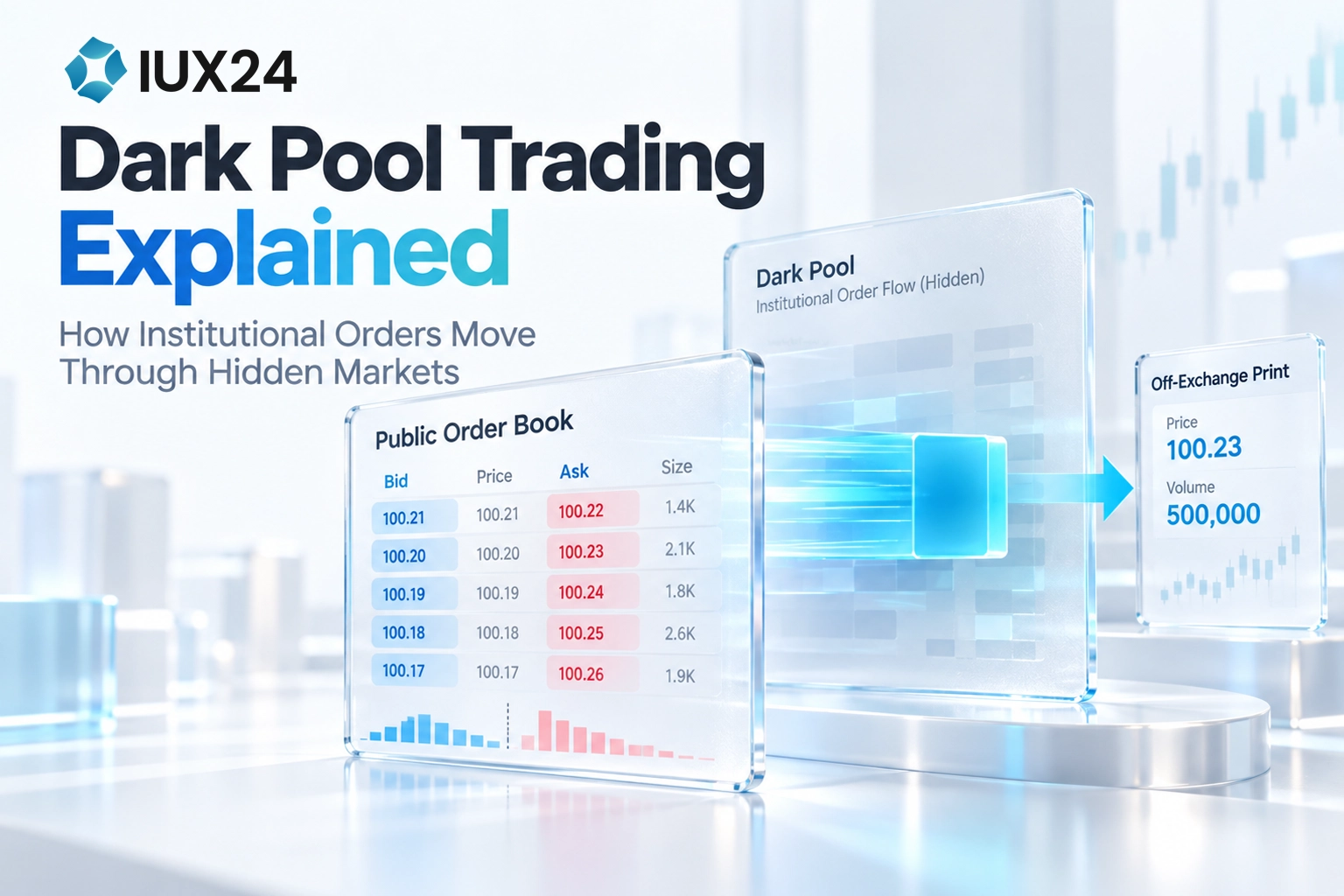
These private trading venues let institutional investors execute large orders without immediately revealing their intention to the broader market. By the time the market knows about the deal, cash and shares have already exchanged hands.
As a retail trader, tracking dark pool activity matters because it can help you understand what smart money is doing in the market.
How do you do this?
In this article, we introduce you to dark pool trading and show you how to read dark pool prints to improve your trading. We’ll cover:
What is dark pool trading?
- How do dark pools work?
- Why do institutions use them?
- Are dark pools legal?
- Why do retail investors care about dark pool data?
- What dark pool data shows and doesn’t
- How to access dark pool data as a retail trader
Curious what the sentiment looks like on a stock right now? Ask Xurve, IUX24’s AI Analyst, and get a real-time read in seconds.
What is dark pool trading?
Dark pool trading refers to trading that occurs on dark pools.
What are dark pools?
They are private trading venues where large institutional investors buy and sell assets without displaying them in a public exchange’s order book.
Dark pools are a type of Alternative Trading System (ATS), the broad category for trading venues that operate outside traditional stock exchanges.
The word “dark” here does not mean illegal or secretive. In fact, the Securities and Exchange Commission (SEC) and the Financial Industry Regulatory Authority (FINRA) regulate them in the US, and the European Securities and Markets Authority (ESMA) oversees them in the European Union (EU).
Instead, it reflects that dark pools don’t have the same transparency as public exchanges. In other words, bids and offers aren’t visible in any order book. The public only learns about the trade after execution.
Who uses dark pools?
The primary participants are institutional investors, including pension funds, mutual funds, insurance companies, sovereign wealth funds, hedge funds, and family offices.
Broker-dealers often operate their own dark pools.
High-frequency trading (HFT) firms also participate in some dark pools, but their presence has raised some concerns. High-frequency traders have been accused of conflict of interest, with many front-running large orders in one pool by trading in other pools or on an exchange.
Retail traders generally can’t access them.
Types of dark pools
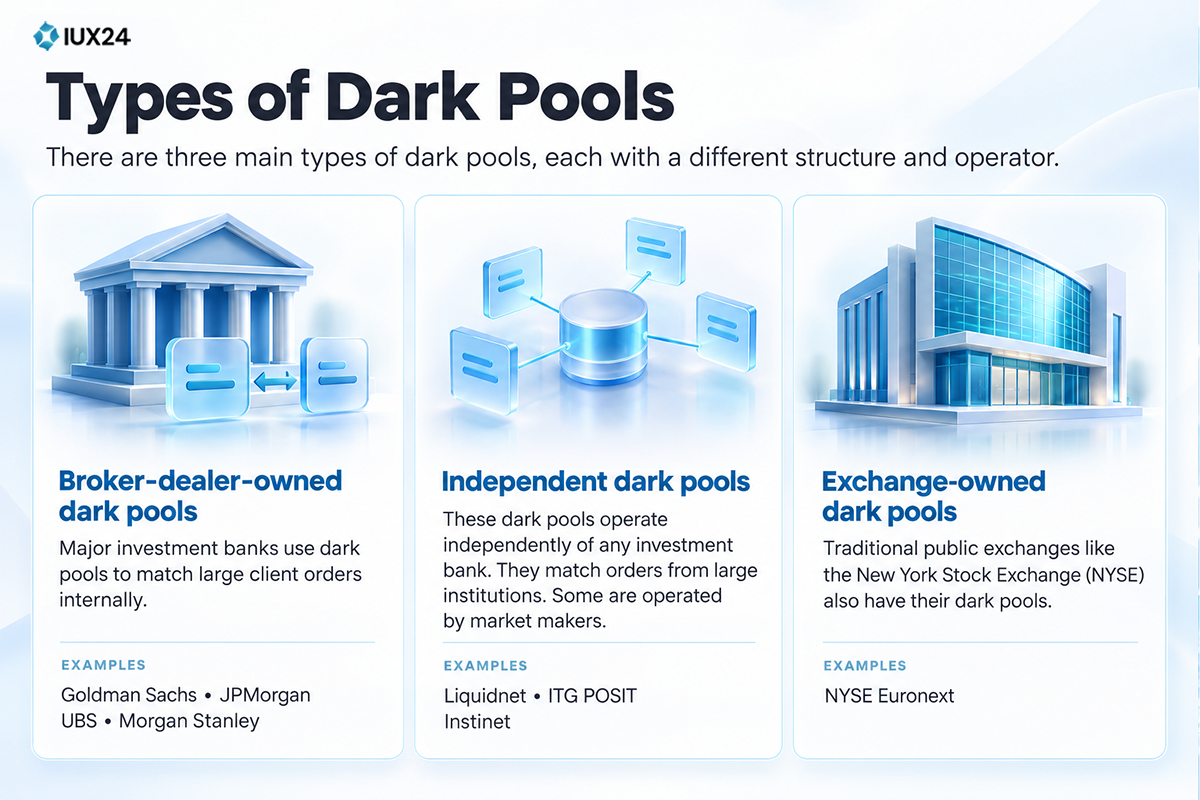
There are three types of dark pools:
- Broker-dealer-owned dark pools: Major investment banks use dark pools to match large client orders internally. Goldman Sachs, JPMorgan, UBS, and Morgan Stanley have all operated them.
- Independent dark pools: These dark pools operate independently of any investment bank. They match orders from large institutions. Market makers operate some of them, and they help improve liquidity by managing the order flow. Popular examples include Liquidnet, ITG POSIT, and Instinet.
- Exchange-owned dark pools: Traditional public exchanges like the New York Stock Exchange (NYSE) also have their dark pools. The NYSE Euronext is an example.
Which assets are traded on dark pools
Stocks remain the most popular dark pool asset. When most retail traders track institutional activity, the focus is often on stocks.
However, assets like options, futures, forex, and cryptocurrencies (such as Bitcoin) are available on certain dark pools.
How do dark pools work?
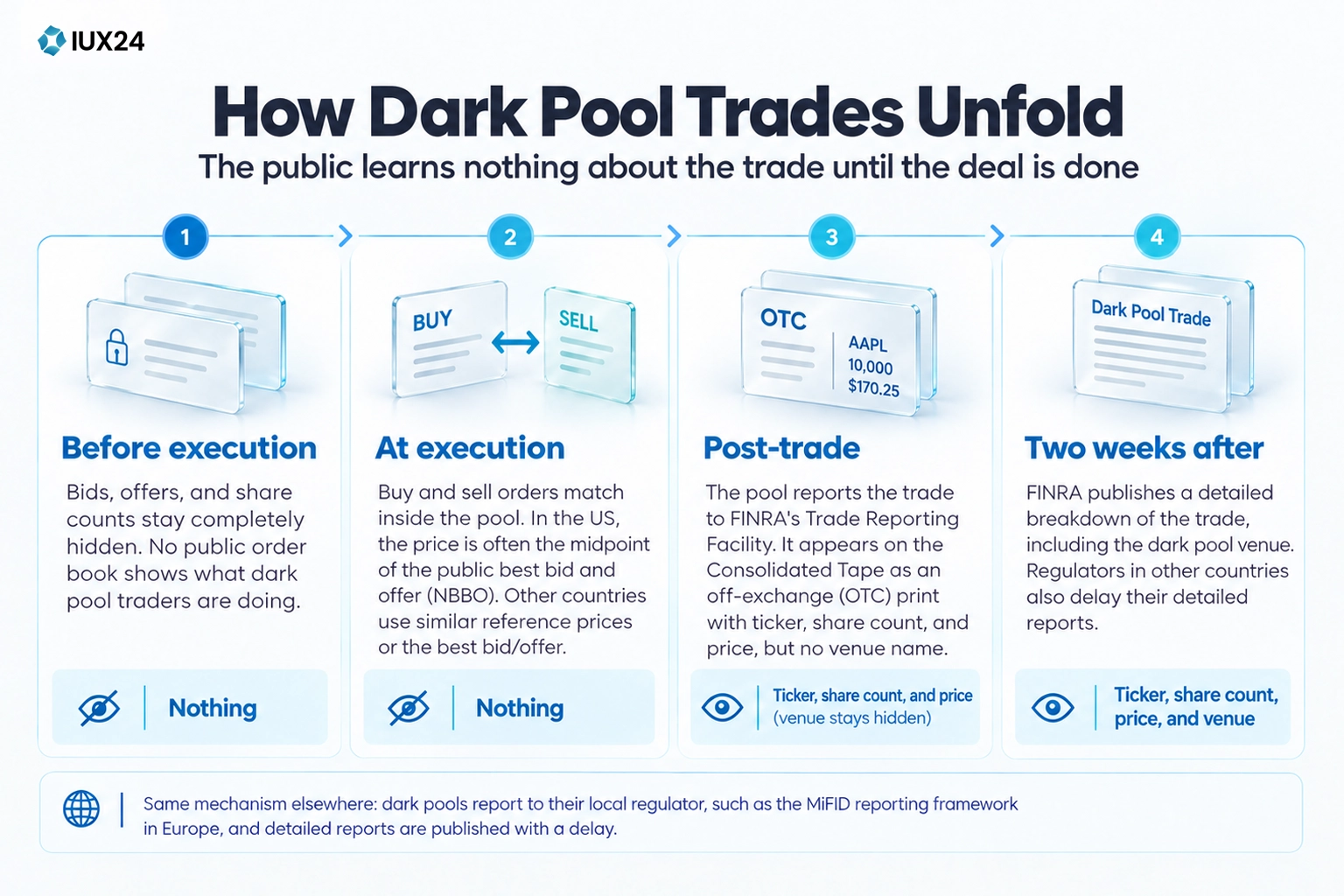
The key point about dark pool trading is that the public doesn’t know about the trade until it’s finalized. They only contribute to the price discovery process after the deal is done.
Below is a timeline of how dark pool trades occur:
- Before execution: The bids, offers, and share counts remain completely hidden. No public order book shows what dark pool traders are doing.
- At execution: Bids and offers match inside the pool. In the US, the final price is often the midpoint of the public National Best Bid and Offer (NBBO). Dark pools in other countries have similar reference prices, or they just use the best bid/offer price.
- Post-trade: After execution, US dark pools report trades to the Trade Reporting Facility of FINRA. The trade now appears on a Consolidated Tape as an off-exchange print or an over-the-counter (OTC) transaction. The record shows the ticker, share count, and final price, but does not name the dark pool venue.
The same mechanism operates in other countries: dark pools report trades to the relevant agency based on their regulatory frameworks. For example, the Markets in Financial Instruments Directive (MiFID) reporting framework takes priority in Europe.
- Some weeks after: In the US, FINRA publishes a detailed breakdown of the trade (including the dark pool venue), two to four weeks after execution. Other agencies in other countries also delay the publishing of the detailed report.
Why do institutions use them?
But why can’t institutions execute block trades on public stock exchanges?
They prefer dark pools for large transactions for a few reasons:
- To reduce market impact: Imagine that a hedge fund bids 2 million shares of AMZN on Nasdaq at $250. If this order appears in the order book, many traders will notice it. They expect that a buy order of that magnitude will cause the price to rise, so they rush in with their own relatively small orders.
Since the hedge fund’s order is large, it’ll probably take time before all of it fills up. By the time it does, the average buy price may be as high as $280, for example.
Why?
The many buy orders from other traders (in an attempt to follow smart money) have pushed the price up, to the loss of the hedge fund. Such a scenario does not play out in a dark pool.
- To benefit from anonymity: Dark pool traders don’t know the identity of the institution on the other side. This allows institutions to protect their trade secrets from competitors.
- To enjoy better execution quality: Since large institutions dominate dark pools, it’s easier to execute large orders without delay (and close to the current market price).
Those same orders take time to execute on public exchanges and, as we have seen, the average price can exceed the market price at the time the order was created.
- To benefit from lower transaction costs: Dark pool trades can cost less than public exchange trades. They avoid exchange and market data fees and focus on the NBBO midpoint, which can be better than taking the full bid-ask spread on a public exchange.
Are dark pools legal?
Dark pools are legal and popular in countries like the United States, Canada, the United Kingdom, the European Union (EU), Australia, Hong Kong, Japan, and Singapore.
In the EU, the MiFID II framework places limits on dark trading activity. For example, only 7% of a stock’s trading volume can be traded on dark pools across the EU, as reported by the
European Securities and Markets Authority.
However, dark pool trading is currently illegal in India, as reported by
AngelOne, an Indian stock broker.
Why do retail investors care about dark pool data?
But why is all of this relevant to you?
You are probably not an asset manager at a mutual fund or a hedge fund.
Well, retail investors show interest in dark pool data because they want to understand what institutional investors are doing. But why care?
- Institutional money shapes markets: Since institutions have larger capital, they can significantly influence price movement. The influence a mutual fund buying 5 million shares has far exceeds that of a retail trader buying 100 shares.
Retail traders try to follow smart money by gaining insights into what institutional investors are doing.
- Identifying support and resistance zones: Some retail traders track dark pool data to identify areas where institutions are consistently trading. These areas are known as dark pool levels or institutional levels.
When institutions trade constantly at multiple levels, the one where volume spikes becomes the most important.
- Monitoring unusual activity: Retail traders also look for spikes in dark pool activity to understand shifting market momentum.
What dark pool data shows and doesn’t
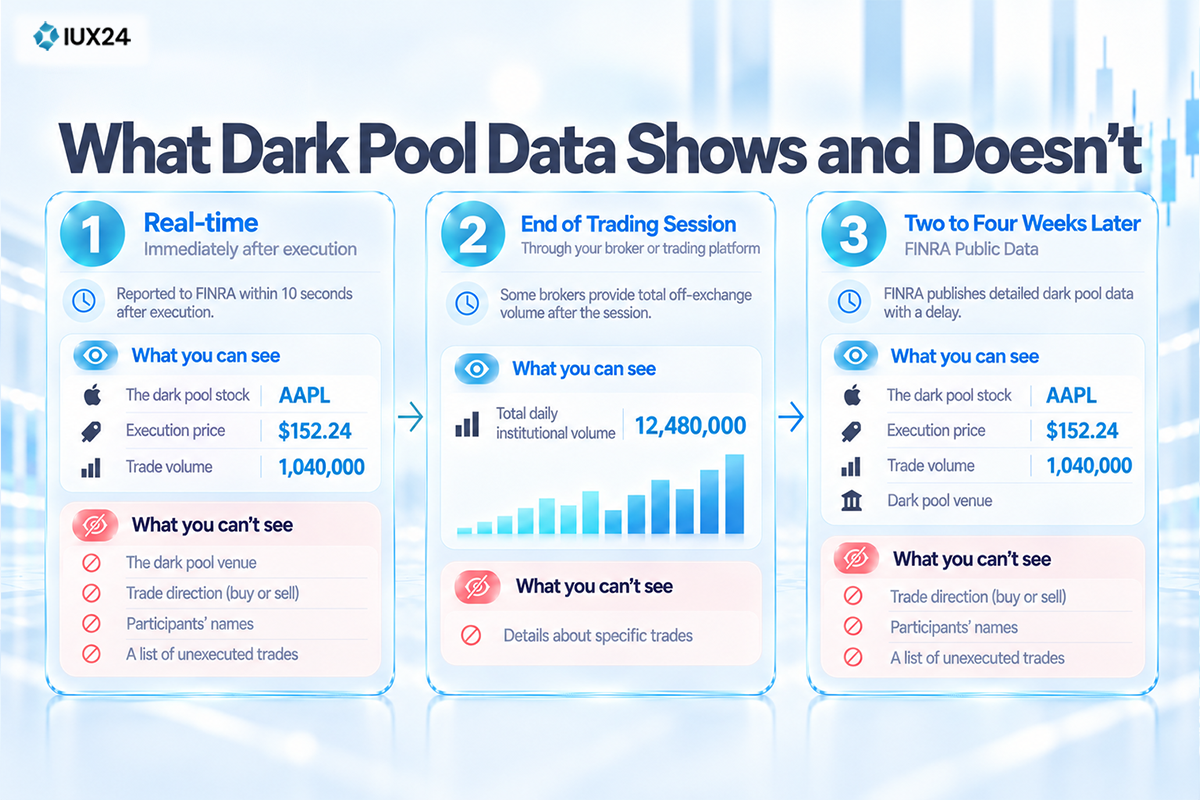
Recall that dark pools report trades to the relevant agency (FINRA in the US) within 10 seconds after execution. At this point, they are added to the Consolidated Tape as an off-exchange print.
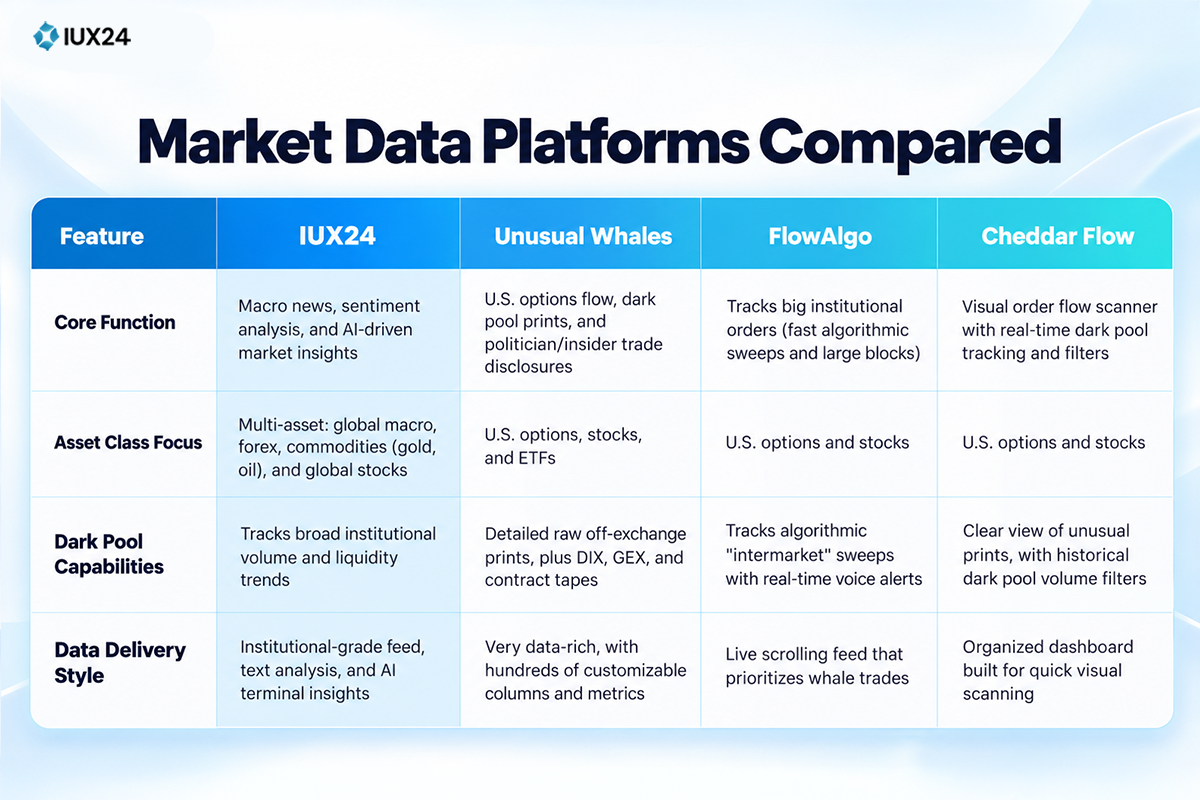
Retail traders using high-speed raw data feeds provided by platforms like IUX24, Unusual Whales, FlowAlgo, and Cheddar Flow can see the dark pool prints at this point.
- What you can see at this stage: The dark pool stock, execution price, and trade volume.
- What you can’t see: The dark pool venue, the trade direction (buy or sell), participants’ names, or a list of unexecuted trades
Some brokers and electronic trading platforms (like Thinkorswim) provide total off-exchange volume at the end of every trading session.
- What you can see at this stage: Total daily institutional volume
- What you can’t see: Details about specific trades
In the US, FINRA publishes data about dark pool trades with a two-to-four-week delay. The data is available for free.
- What you can see at this stage: The dark pool stock, execution price, trade volume, and dark pool venue
- What you can’t see: Trade direction, participants’ names, or a list of unexecuted trades
How to read dark pool prints
What is available and unavailable on a dark pool print has certain implications for you as a retail trader.
- Don’t use them as trade signals: The most important thing is that dark pool data cannot be treated as a buy or sell signal.
A dark pool print does not show if the trade is a buy or sell order, only that it took place. Also, it does not reveal participants’ motivation or beliefs about the market. Since we are dealing with institutions, they frequently hedge market orders with derivatives, but a dark pool print does not show that.
“When tracking these transactions, treat the data as a single component of your broader financial modeling and risk management framework,” according to Michael Spitz, founder of
Spitz CPA, a fractional CFO platform. “A major risk is mistaking complex multi-leg institutional hedging or delayed transaction reporting for direct directional conviction, which can distort your capital strategy.”
“Treat dark pool prints as a single component of your broader financial modeling and risk management framework.”
Michael Spitz, Founder of Spitz CPA
- Use them to understand institutional interest: Dark pool data can show that institutions are interested in a stock. This can indicate that the stock has strong liquidity and that financial experts see something in it. You’ll probably find significant research about such stocks online.
Also, dark pool prints can reveal specific zones where institutions are trading. You can mark such zones as key levels during your technical analysis.
Finally, they can help you understand why price sometimes acts strangely.
“Retail traders do not need to chase every dark pool print,” according to Theodore Alatsas, founder of Alatsas Law Firm, an estate planning and asset protection practice. “But if you trade individual stocks or options, it can help explain why price behaves oddly when visible volume does not tell the whole story.”
“If you trade individual stocks or options, dark pool prints can help explain why price behaves oddly when visible volume does not tell the whole story.”
– Theodore Alatsas, Founder of Alatsas Law Firm
- Understand data timing: If you rely on official dark pool prints, understand that you are dealing with delayed data and avoid treating it as real-time data.
You can avoid this problem by accessing real-time data from platforms like IUX24.
- Use dark pool prints as one indicator among many: A dark pool indicator provides useful information about institutional activity, especially the specific zones they are trading from.
Combine this with fundamental, technical, and sentiment data so you can form a comprehensive view of where price is likely going.
How to access dark pool data as a retail trader
IUX24 is a market intelligence platform bringing institutional-grade data and analysis to retail traders like you.
Our Dark Pool Tracker provides dark pool prints that give you insights into institutional orders that do not appear on public exchanges’ order books.
With us, you can access data like the stock ticker, execution price, and trade volume seconds after the dark pool reports it to the relevant agency. Such real-time data provides you with relevant insights into institutional activity.
But it doesn’t stop there.
Thorough analysis also requires knowledge of fundamental and sentiment data. Our AI Sentiment product aggregates sentiment data from news, expert analysis, and social media discussions. We also provide
market news and
detailed market analysis for fundamental analysis.
Note: We do not provide buy and sell signals and do not execute trades.
Below is a comparison of our platform with other dark pool activity trackers.
You can synthesize all the data points we provide with Xurve AI Analyst, our AI chatbot. With this, you can follow up on the market news, market analysis reports, sentiment data, and dark pool prints, and create a comprehensive outlook on the relevant asset.
Ready to research smarter, not harder, with access to institutional-grade market intelligence? Get started with IUX24 today.
Takeaways
Dark pools are private trading venues that help institutional investors execute transactions without displaying their full orders on public exchange order books before execution.
Transaction prices and volumes can help retail traders identify notable institutional activity, but prints do not confirm whether institutions are buying or selling.
Dark pool levels can inform technical analysis. Areas with concentrated trading activity may be worth monitoring as potential support or resistance zones, especially when price action and other market indicators provide confirmation.
Combine dark pool data with other market signals. Tracking prints alongside market news, technical indicators, and sentiment analysis provides broader context than relying on individual transactions as buy or sell signals.
Frequently Asked Questions
- How can retail investors see dark pool activity?
Retail investors can track dark pool activity through market intelligence platforms such as IUX24’s Dark Pool Tracker, which displays reported prints with details such as stock ticker, execution price, and trade volume. They can also access public off-exchange trading data, although these are published with a delay.
- Do dark pool prints mean institutions are buying?
No. Dark pool prints confirm that transactions have occurred, but they do not independently reveal whether institutions are buying or selling, their trading intentions, or their overall market outlook.
- Is there free dark pool data?
Yes. In the US, FINRA provides free public data on off-exchange trading, including alternative trading system activity and venue-level information published with a delay.
- How much of the market trades in dark pools?
The proportion varies by market, security, and period, so there is no single percentage that applies universally.
This guide is for education only and isn’t financial advice. Investing involves risk, and you could get back less than you put in.




Leave a Reply