
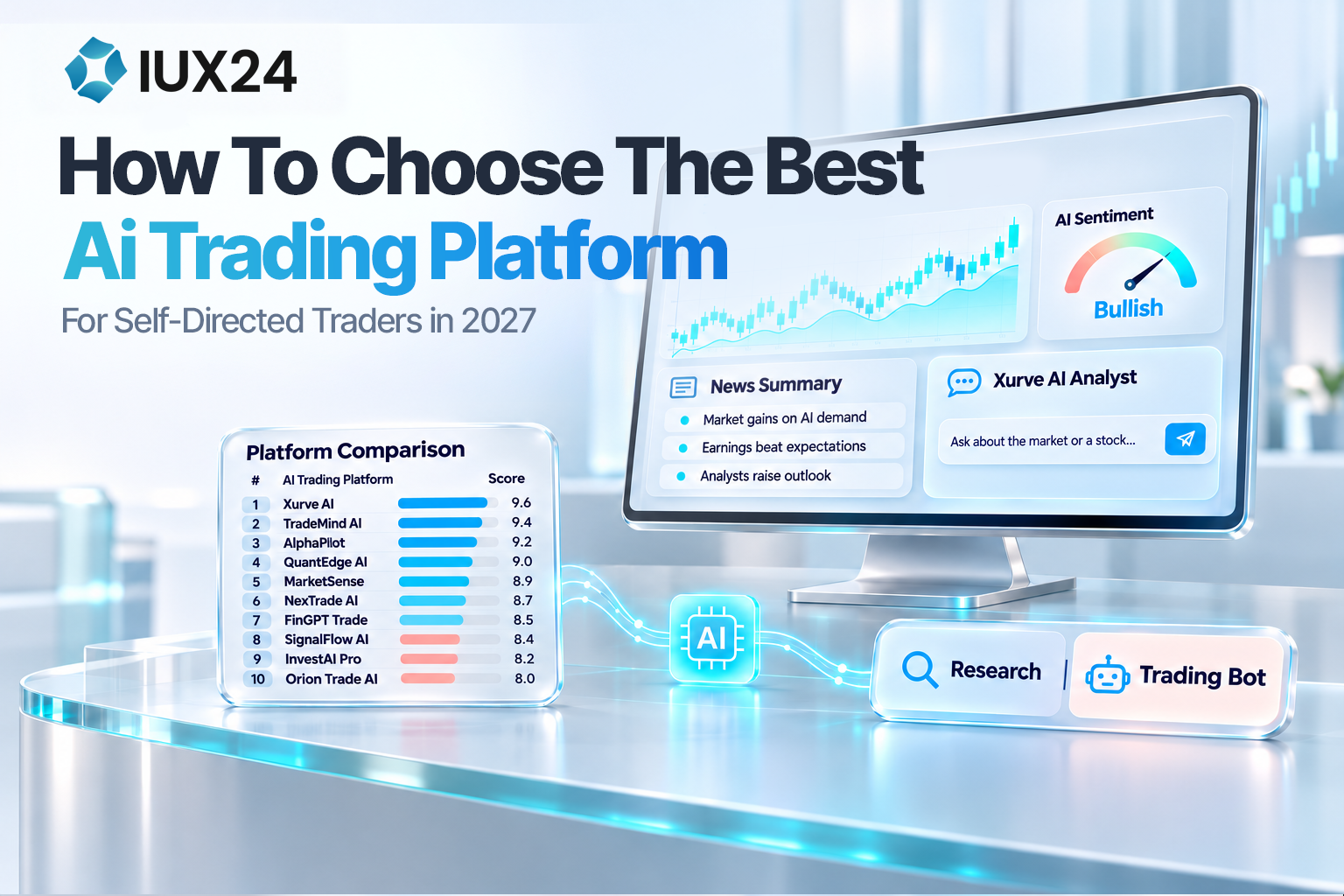
Searching for the best AI trading platforms produces a list of dozens of tools that claim to give self-directed investors an edge in the market.
Yet not all of them do. Some use artificial intelligence well and can help you improve your research and decision-making, but many simply add the “AI” tag to old features.
Also, even if these tools do use genuine AI analysis, not all of them are reliable. Sometimes they won’t show their reasoning, or are not clear about what the service they offer actually means. These things are important to investors who are putting their hard-earned money on the line.
This guide aims to clear up these doubts. We researched a list of AI trading platforms and assessed them on six key criteria, from compliance to cost. The list of 10 tools below are those that matched these standards most closely, with each’s limitations listed along with its strengths.
Note: IUX24 has included its own trading platform in this list but has faced the same scrutiny as the rest.
Contents
- How We Picked and Ranked the Best AI Trading Platforms
- The 10 Best AI Trading Platforms for 2027
- AI Trading Platforms Compared: Pricing and Features (table, dated)
- AI Research Platform vs AI Trading Bot: What’s the Difference?
- Do AI Trading Platforms Actually Work?
- Where AI Trading Platforms Are Heading in 2027
- How to Choose the Best AI Trading Platform for You
- FAQs
Curious what the sentiment looks like on a stock right now? Ask the Xurve AI Analyst and get a real-time read in seconds.
How We Picked and Ranked the Best AI Trading Platforms
AI trading tools must meet high standards to win the trust of retail investors. Not all of them succeed, however, so it pays to be cautious about which one to use.
Each platform on this list was scored on the following six criteria, though none is perfect on every count.
- Is it transparent and compliant? Platforms must be clear about what purpose they serve, so we favored those that plainly state whether they offer advice or information and come with clear risk warnings.
- How deep does its AI capability go? The technology is now able to use natural language processing (NLP) to perform real analysis, instead of relabeling standard indicators that have been used for years.
- Can the tool explain its analysis? Many black-box tools can’t back up their findings, but the investor should always be able to challenge and question it.
- How much data does it cover? As an investor, you should see the historical data it uses, the assets it covers, and which institutional-grade signals (such as capital flows) you get access to.
- How easy is it to use? Complex tools simply add to the frustration of many investors trying to understand the technology. We’ve made plain-English outputs and a short learning curve key requirements.
- How much does it cost? Many tools offer free versions and, with paid tiers, they should always explain exactly what you get.
The 10 Best AI Trading Platforms
Disclosure: This article is published by IUX24. Our placement reflects our own assessment against the criteria above; readers should judge it accordingly.
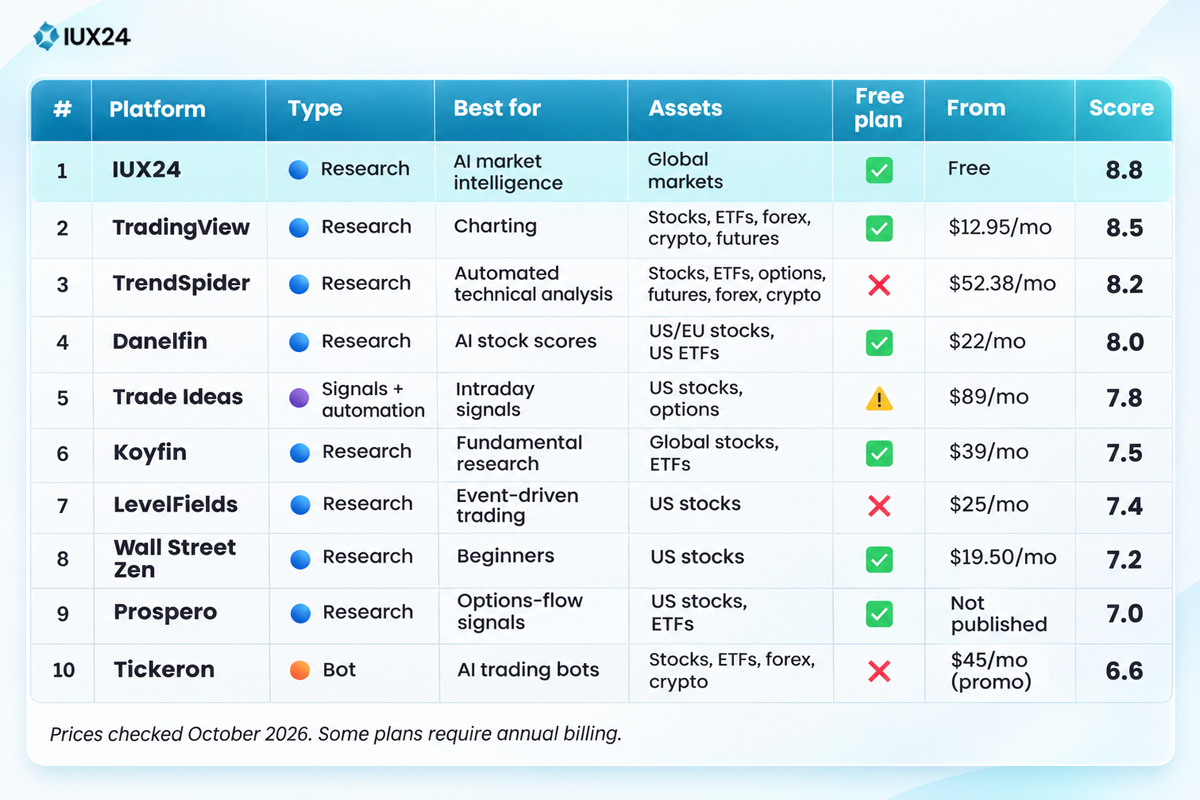
The 10 Best AI Trading Platforms at a Glance
1. IUX24: Best for AI-Driven Market Intelligence
IUX24 is an AI investment intelligence platform with a clear purpose: to give self-directed investors the same kind of data and AI-driven analytics that institutions use.
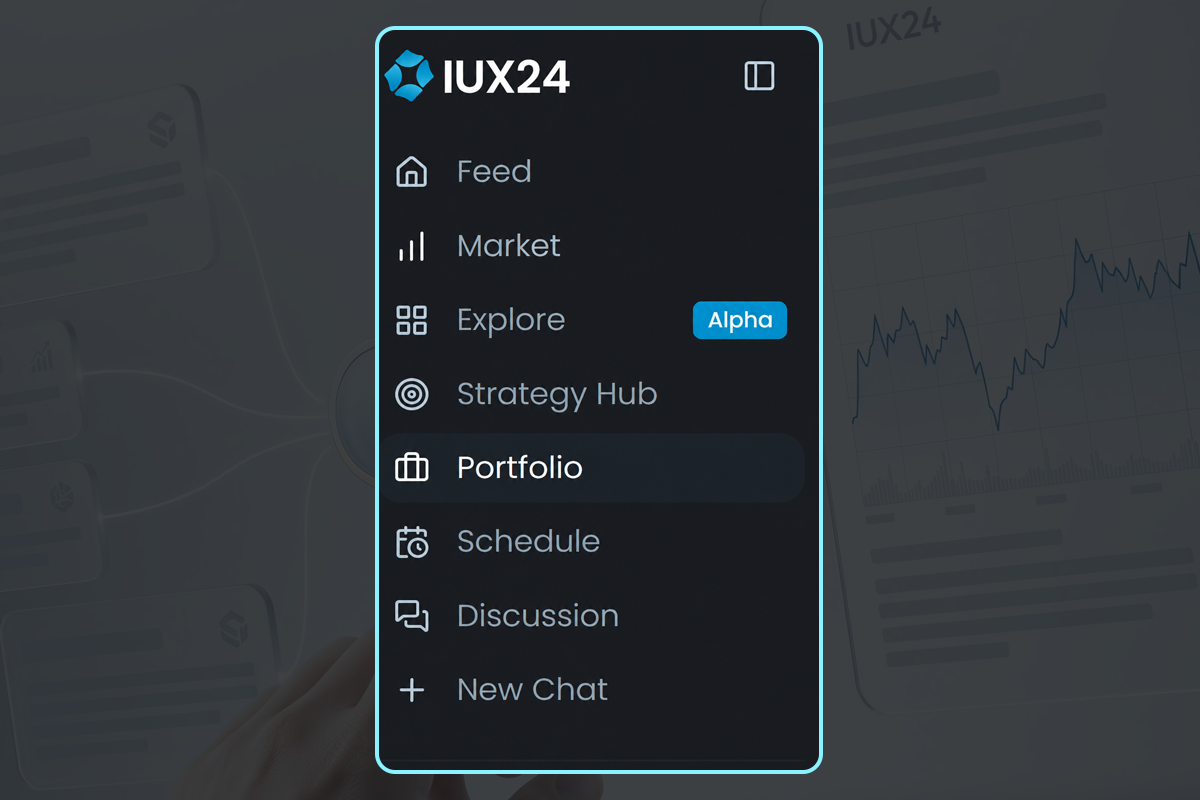
Its Intelligence Terminal is at the heart of the IUX24 ecosystem. Operating as a digital command center, it brings four research pillars into one place:
- Xurve AI Analyst: A conversational agent that synthesizes news, sentiment, and technical data into plain-English analysis that investors can interact with. Quick to use and easy to challenge, it responds to questions and explains its reasoning.
- AI Sentiment analysis that uses natural language processing to detect and interpret changes in global market psychology, including separating genuine market moves from social media chatter.
- Strategic market insights collated from unbiased news sources and converted into short, structured reports that help investors make sense of market moves at a glance. Core tools such as a stock screener, an economic calendar, and heat maps help to turn these insights into a focused watchlist.
- A Dark Pool Tracker (in beta mode) that monitors large off-exchange dark pool trading moves that have traditionally been out of view for retail investors.
Launched in November 2025, IUX24 currently offers institutional information and analysis for free.
Price at the time of writing: Free, during early adoption
Best for: Investors wishing to access elite data and analysis without paying a terminal subscription.
Score: 8.8/10
Note: IUX24 is not a broker and does not execute trades, so you’ll need a separate brokerage account. It is also not affiliated with the similarly named brokerage IUX Markets.
2. TradingView: Best for Charting and Technical Analysis
TradingView’s community of over 100 million users makes it the leading charting tool for retail trading.
It has 21 types of charts for traders to use ,and its built-in pattern recognition automatically recognizes chart patterns. Traders can also build and backtest their own strategies with Pine Script.
The platform comes with an AI screener and real-time exchange data, but you must pay for these features. There’s also no institutional flow or sentiment data to analyze.
Price at the time of writing: Free; with paid plans from $12.95 to $199.95 per month (billed annually).
Score: 8.5/10
3. TrendSpider: Best for Automated Technical Analysis
TrendSpider uses machine vision to detect the trendlines and patterns that make chart work challenging for many investors.
Traders can build and test strategies on machine learning models with Quanty Lab, its dedicated strategy-building workspace. ETFs, futures, stocks, options, forex, and crypto form the bulk of its asset coverage list.
The platform scores well with AI features thanks to its AI-powered backtesting and Sidekick AI assistant that you can interact with as soon as you land on the site. However, its advanced features can be difficult to get to grips with.
Price at the time of writing: Package prices are more complex than other platforms. At the time of writing, the standard version starts at $52.38 per month in the first year, rising to $79.54/month after that, with a paid 14-day trial at $19.
Score: 8.2/10
4. Danelfin: Best for AI Stock Scores
Stock scoring with AI is popular among investors, and Danelfin is one of the strongest options for rating US and European stocks this way. Its built-in AI score estimates how likely each is to outperform the market, and it shows the technical, fundamental, and sentiment signals behind each score.
The free tier gives you 10 reports a month, and no plan includes trade execution. It’s also important to remember that its AI scores are not predictions, but probabilities.
Price at the time of writing: Free; paid plans from $22/month.
Score: 8.0/10
5. Trade Ideas: Best for Intraday Signals
Trade Ideas’ Holly AI backtests its strategy bank daily and fires intraday signals with entry and exit levels. Its OddsMaker tool lets users backtest their own scans, while the Brokerage Plus feature lets them use the platform’s “Money Machine” for automated trading.
One notable downside is that it only covers US equities and options, which may not satisfy the scope of many traders.
Price at the time of writing: $89/month (Standard) or $178/month (Premium, with Holly AI), billed annually.
Score: 7.8/10
6. Koyfin: Best for Fundamental Research
Koyfin positions itself as the best Bloomberg alternative and offers high-quality data and portfolio management tools within its platform package.
Users can access the last decade of financials, estimates from analysts,and ETF screenings
Koyfin offers Bloomberg-style research at a retail price. Users can access the last decade of financials, analyst estimates, earnings transcripts, and ETF screening.
The platform’s AI features are limited, but you can converse with Koyfin AI, its on-site bot, to navigate around the site and its tools.
Price at the time of writing: Free basic version. Its Plus model is $39/mont,h and Premium costs $79/month.
Score: 7.5/10
7. LevelFields: Best for Event-Driven Trading
With LevelFields AI, traders can monitor 6,300 stocks across 24 catalyst types, including buybacks to CEO changes. They can also see how prices historically reacted to each to help with their decision-making.
The platform only covers US stocks, however, and there’s no free version available at the time of writing.
Price at the time of writing: From $25/month on an annual plan
Score: 7.4/10
8. Wall Street Zen: Best for Beginners
Investors looking for simplified stock screening may like Wall Street Zen. It provides Zen Ratings, a quant model that uses a lettered system (A-F) to grade US stocks across 115 factors.
The platform lacks real-time trading tools, which makes it better suited to longer-term research than active trading.
Price at the time of writing: Free Basic plan, and a Premium plan $19.50/month billed annually.
Score: 7.2/10
9. Prospero: Best for Options-Flow Signals
Investors using Prospero.ai’s app can turn options trading activity into simple signals which they can use to better inform their decisions. They have access to a Net Options Sentiment indicator that refreshes every few minutes.
Its institutional flow data comes from SEC filings, however this can sometimes lag real positions by six weeks or more. Stocks and ETFs are limited to the US market.
Price at the time of writing: free; with no information on premium tier pricing available.
Score: 7.0/10
10. Tickeron: Best for AI trading bots
Tickeron brings AI-powered stock analysis, forecasts, and trading signals together in one platform. Its AI robots can issue entry and exit signals and recognize patterns across stocks, ETFs, forex, and crypto.
Price at the time of writing: Its various promotions change pricing regularly so it is difficult to pin down, and there are various add-ons and discounts that might apply. There is no free plan.
Score: 6.6/10
AI Research Platform vs AI Trading Bot: What’s the Difference?
AI research platforms and trading bots cover two different areas of the trading process. Investors typically use platforms to access and analyze the latest market data. Research tools such as IUX24, Danelfin and Koyfin come equipped with AI analysis and data tools that help them make sense of events, and the onus is on the investor as to how they react.
AI trading bots, meanwhile, focus on the automated execution of trades on your behalf. They often use algorithmic trading methods to do this without you approving each trade. Instead, as the investor, you set general parameters for them to follow.
Common types of trading bot include:
- Expert Advisors on MetaTrader 5. These are custom scripts that trade forex and other markets automatically.
- Strategy marketplaces like StockHero where you can rent ready-made bots built by other traders.
- Copy trading, which lets you automatically mirror other investors’ positions.
- DCA bots. These automate dollar-cost averaging and buy fixed amounts at set intervals. This is popular in crypto trading.
Trading bots must connect to a brokerage account that supports it. Brokers whose accounts commonly connect to trading tools include:
- Robinhood
- Webull
- Moomoo
- E*TRADE
- Interactive Brokers
- TradeStation
As an investor, the AI trading bot you opt for depends on how much experience you have and how much control you’re willing to give up.
Some platforms offer a paper-trading mode for you to test it out, which is a sensible move, while some offer free versions. Free or not, an AI stock trading bot still risks real money once it goes live.
Do AI Trading Platforms Actually Work?
An AI trading platform can help you improve how you trade your money, but there is no such thing as risk-free trading. AI cannot predict the stock market; instead, it spots patterns and sentiment shifts to estimate probabilities, and it does this much faster than humans can.
Instead, it’s how you use such a tool that counts, instead of uncritically depending on it. “I would never just ask an AI whether to go long on a stock and act on the answer alone,” says Vasant Dhar, an NYU Stern professor who founded one of the first machine-learning hedge funds. “Instead, AI changes where the real work happens. People can ask the machine to run the analysis and spend their own time asking better questions instead.”
“AI changes where the real work happens. People can ask the machine to run the analysis and spend their own time asking better questions instead.”
– Vasant Dhar, Professor at NYU Stern
This reasoning lies at the heart of how modern AI trading platforms can help investing strategies. They can help carry out the analysis as long as the human using it continues to question it, including the platform’s own performance claims.
The safest approach is to test any tool with paper trading first, then commit small amounts of real money only once you understand how it behaves.
Trading involves significant risk, including the loss of your capital. Nothing in this article is investment advice.
Where AI Trading Platforms Are Heading in 2027
Complex dashboards and paywalled data look set to become a thing of the past as a new wave of AI trading tools aims to use the latest technology to decipher complex market data and deliver insights to self-directed investors in plain English.
This data includes institutional flows that were previously out of reach, such as dark pools and options activity, although this may still arrive with delays and gaps for some time yet.
AI-powered trading apps are also helping to narrow the gap between these insights and executing trades. This will still need human oversight as discipline matters more than ever, but it cuts the time between spotting an opportunity and acting on it.
Yet, as with any new technology, regulators are likely to scrutinize AI-generated signals more closely than ever before. In February 2026, the Central Bank of the UAE told financial institutions to explain AI-driven decisions to customers and let them request human review. Clearer disclosure rules and stronger investor protections look set to follow.
How to Choose the Best AI Trading Platform for You
The best AI trading platform for a beginner is rarely the most powerful one, but the one that fits how you invest.
To find the most suitable choice for you you work, ask yourself these five questions:
- Do you want research or automation? Research platforms support your decisions, while bots make them for you. Beginners usually learn more from the first.
- Which assets do you trade? Several tools on this list cover US stocks only. If you trade forex, crypto, or options, it’s best to check coverage first.
- What’s your budget? Start with a free tier and only upgrade when you hit a real limit.
- Can you verify its track record? Look for transparent methods and independent reviews, not just headline returns.
- Does it fit your brokerage account? If the tool executes trades, confirm it supports your broker before you pay.
Whichever platform you choose, treat AI as a sharp research partner.The smartest investors over the next few years will be those who challenge and question AI instead handing all of their decisions over to it.
Ready to research smarter, not harder? Get started with IUX24 today.
FAQs
What is the best AI trading platform for beginners?
Look for plain-English outputs and a free tier if you are new to trading. IUX24 and Wall Street Zen are both built with newer investors in mind.
Is there a free AI trading platform?
Yes. IUX24 is free during early adoption, and TradingView, Koyfin, Danelfin, Wall Street Zen, and Prospero all offer free plans with limited features.
What is the difference between an AI trading bot and an AI research platform?
A research platform analyzes data to inform your decisions. A bot places trades for you automatically through a connected brokerage account.
Can AI predict the stock market?
No. AI can identify patterns and probabilities, but no tool can reliably predict market moves.
What are the best AI stock trading platforms?
Our top picks are IUX24, TradingView, and TrendSpider, but the right choice depends on your goals, assets, and budget.

Leave a Reply